US company Oasys Water to sale forward osmosis (FO) technology IP after cash-flow issue

US company Oasys Water is exploring a sale of its forward osmosis (FO) technology IP after its cash-flow has run dry. The company became a much-needed success story for the niche FO technology, winning numerous industry awards and securing multiple rounds of funding. So what happened? The company was founded in 2008 by Rob McGinnis, developing technology which began at Yale University under Dr Menachem Elimelech. McGinnis then directed technology development as CTO until 2012. The firm closed $10 million in Series A financing in 2009 and raised a further $15 million in Series B funding five years later […]

US company Oasys Water to sale forward osmosis (FO) technology IP after cash-flow issue2017-12-07T08:43:07+01:00

DME e.V. -Prämierung der besten Abschlussarbeiten aus dem Sommersemester 2016

Im vergangenen Sommersemester 2016 wurde zum zweiten Mal eine DME e.V. Studienprämie für die besten Abschlussarbeiten auf den Gebieten der „Entsalzung“, des „Water Reuse“ und der „ZLD“ ausgeschrieben und mit Bewerbungen aus 5 Hochschulen gut angenommen. Die eingesandten Arbeiten wurden von 2 Gutachtern aus dem Vorstand der DME e.V. bewertet und streng vertraulich nach festgelegten Kriterien eingeordnet. Alle Bewerbungen waren dem Themengebiet „Entsalzung“ zuzuordnen und lagen in der Bewertung dicht beieinander. Daher gibt es in diesem Semester drei Gewinner:

Platz 1: Christian Linnartz vom Lehrstuhl für Chemische Verfahrenstechnik von der RWTH Aachen (Prof. Dr.-Ing. Matthias Wessling und Dr.-Ing. Süleyman Yüce)

mit seiner Arbeit zum Thema

„FCDI-Flow-Elektrode […]
DME e.V. -Prämierung der besten Abschlussarbeiten aus dem Sommersemester 20162017-12-05T18:07:29+01:00

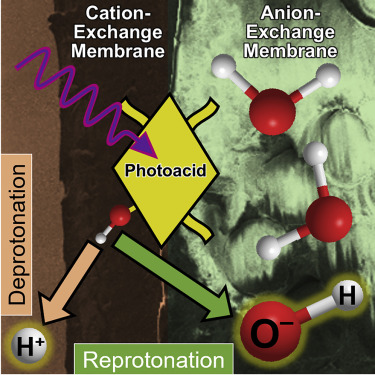
Conversion of Visible Light into Ionic Power Using Photoacid-Dye-Sensitized Bipolar Ion-Exchange Membranes

…

Here, we report a ∼60-fold increase in the photovoltage through use of a bipolar membrane structure consisting of a cation-exchange membrane affixed to an anion-exchange membrane. The junction between the layers was characterized in detail using electrochemistry, scanning electron microscopy, spectroscopy, and thermal gravimetric analysis. Our results represent considerable progress toward a device that directly converts sunlight into ionic electricity, which has implications for direct solar desalination of salt water. …

Introduction

It has been over three-quarters of a century since the discovery of the semiconductor pn-junction diode, […]

Conversion of Visible Light into Ionic Power Using Photoacid-Dye-Sensitized Bipolar Ion-Exchange Membranes2017-11-28T07:41:22+01:00

Nuclear Desalination – IAEA

Desalination Thermodynamic Optimization Program (DE-TOP)

DE-TOP has been developed by the International Atomic Energy Agency as a tool for the thermodynamic analysis and optimization of nuclear cogeneration systems (currently with options for nuclear desalination and district heating applications). DE-TOP can be used to models the steam power cycle (Rankine cycle) of different water cooled reactors or fossil plants, and the coupling with any other non-electrical application. With an intuitive graphical user interface and flexible system configuration, the user can select different coupling arrangements between power plant and non-electric application (single steam extraction, multiple steam extraction, backpressure operation, etc.). DE-TOP […]

Nuclear Desalination – IAEA2017-11-26T21:03:16+01:00

Solar-powered device generates electricity through ion transport and could lead to low-cost for seawater desalination

By binding photosensitive dyes to common plastic membranes and adding water, chemists at the University of California, Irvine have made a new type of solar power generator. The device is similar to familiar silicon photovoltaic cells but differs in a fundamental way: Instead of being produced via electrons, its electricity comes from the motion of ions. Dubbed the “synthetic, light-driven proton pump” by its creators, the innovation – because of its ionic basis – has the added potential capability of taking the salt out of seawater. “The materials used to make such a device can be dirt-cheap,” said Shane Ardo, […]

Solar-powered device generates electricity through ion transport and could lead to low-cost for seawater desalination2017-11-17T11:33:30+01:00

Hochschule Karlsruhe entwickelt ein innovatives Konzept zur Trinkwasseraufbereitung Karlsruhe – Germany

….

Hochschule Karlsruhe will Lösungen entwickeln. Im Oktober fand an der Hochschule Karlsruhe ein Symposium zum Verbundprojekt „WaKap“ („Modulares Konzept zur nachhaltigen Wasserentsalzung mittels Kapazitiver Deionisierung am Beispiel Vietnam“) statt. Unterstützt wird dieses Projekt vom Bundesminsterium für Bildung und Forschung (BMBF) mit über 900.000 Euro. „WaKap“ startete im September 2016 und wird durch Prof. Dr. Jan Hoinkis von der Hochschule Karlsruhe koordiniert. Während des Workshops wurden zusammen mit den Projektpartnern die bisherigen Projektergebnisse sowie die Aktivitäten anderer Forschungsgruppen vorgestellt und diskutiert. Anlage bereitet Grundwasser neu auf. Im „WaKap“-Projekt soll ein energieeffizienter, modularer Kombinationsprozess zur Entsalzung von Meer-, Brack- und Grundwasser […]

Hochschule Karlsruhe entwickelt ein innovatives Konzept zur Trinkwasseraufbereitung Karlsruhe – Germany2017-11-15T16:12:56+01:00

Studentenförderung WS 2017 / 2018: Stipendienvergabe!

DME e.V. vergibt auch im WS 2017/2018 Stipendien!

Bewerben Sie sich JETZT um ein Stipendium, wenn Sie folgende Voraussetzungen erfüllen:

Sie sind Student im Masterstudiengang an einer deutschen Hochschule
Sie können einen Bachelor-Abschluss vorweisen
Sie bringen besonderes Interesse an dem Themengebiet der Entsalzung mit
Bitte richten Sie Ihr Bewerbung  bis zum   30. November 2017   an

ute.hoffmann@dme-ev.de

oder

DME Deutsche Meerwasserentsalzung e.V.
Ute Kimm-Hoffmann
Bergheideweg 26 d
47447 Moers

(LINK!!!)

Studentenförderung WS 2017 / 2018: Stipendienvergabe!2017-11-15T15:44:42+01:00

FORBLUETM is new Asahi Glass (AGC) brand of separation solutions for various chemicals – Tokio – Japan

…

AGC kommt mit Einführung der neuen Marke „FORBLUE (TM)“ dem zunehmenden Bedarf im Bereich chemische Abscheidung entgegen.

Verglichen mit herkömmlichen Produkten auf dem Markt verfügt die „S-Serie“, die erste neue Serie der „FORBLUE (TM)“-Marke, über eine größere Bandbreite an Ionenaustauschkapazitäten und Kation-Selektivität, die es dem Kunden ermöglicht, je nach Anwendung die passende Membran auszuwählen. Die S-Serie integriert außerdem ein verstärktes Spezialgewebe, dass die Handhabung, Dimensionsstabilität und mechanische Festigkeit der Membranen verbessert, die sich aufgrund dieser Eigenschaften in einem breiten Elektrolyse- und Elektrodialyse-Anwendungsspektrum für eine Vielzahl von Chemikalien mit hohem Wirkungsgrad und stabilem Betrieb einsetzen lassen. Weitere […]

FORBLUETM is new Asahi Glass (AGC) brand of separation solutions for various chemicals – Tokio – Japan2017-11-15T15:37:49+01:00

Anfiro Inc., a water technology startup closed $1.1 million seed round with support from PRIME Coalition – Cambridge – Maine

…

The financing enables the development of Anfiro’s energy-efficient water membranes shown to reduce the cost and energy of desalination and water treatment, providing affordable freshwater and reducing greenhouse gas emissions at global scale. The technology was developed at and licensed from Purdue University and the University of Notre Dame to Anfiro.

…

As the climate changes and existing freshwater sources are stressed, freshwater scarcity is only expected to worsen in the years ahead. Anfiro is attacking this problem by developing novel water filtration membranes that reduce the cost of water treatment. Anfiro’s next-generation membranes can […]

Anfiro Inc., a water technology startup closed $1.1 million seed round with support from PRIME Coalition – Cambridge – Maine2017-11-07T11:10:52+01:00

Tuning a circular p–n junction in graphene from quantum confinement to optical guiding – Rutgers University-New Brunswick

Abstract

The photon-like propagation of the Dirac electrons in graphene, together with its record-high electronic mobility1,2,3, can lead to applications based on ultrafast electronic response and low dissipation4,5,6. However, the chiral nature of the charge carriers that is responsible for the high mobility also makes it difficult to control their motion and prevents electronic switching. Here, we show how to manipulate the charge carriers by using a circular p–n junction whose size can be continuously tuned from the nanometre to the micrometre scale7,8. The junction size is controlled with a dual-gate device consisting of a planar back gate and […]

Tuning a circular p–n junction in graphene from quantum confinement to optical guiding – Rutgers University-New Brunswick2017-10-26T10:07:12+02:00
Nach oben