Preparation of fully coated PEDOT: PSS film on MXene for high reliability capacitive deionization – China

In this paper, the sandwich PEDOT:PSS@MXene film electrode was prepared by uniformly coating PEDOT:PSS film on the surface of MXene through template-assisted polymerization. The film improves the stability of the composite by protecting the Ti layer.

The specific capacitance of PEDOT:PSS@MXene performs 185.5 F g−1 at 5 mV s−1. The desalination capacity of hybrid AC//PEDOT:PSS@MXene cell in 500 mg L−1 NaCl solution is 35.8 mg g−1.

After 40 desalting cycles, the cell performs better retention rate than AC//MXene cell (82.5 %), which keeps 97.2 %.

The morphology and structure of composite show no exists of TiO2 […]

Preparation of fully coated PEDOT: PSS film on MXene for high reliability capacitive deionization – China2024-11-29T11:27:15+01:00

Structure-function relationship for functional films with constructed graded channels in dye/salt separation and fouling resistance (China)

A novel composite film, constructed through polypyrrole particle stacking and polydopamine space-filling, demonstrates exceptional performance in dye/salt separation with high water flux (>600 L m⁻² h⁻¹ bar⁻¹) and near-perfect dye rejection (~100%).

The film’s unique patterned surface structure, created by microsphere arrangement and inter-structure adaptation assembly, provides excellent contamination tolerance and rinsing regeneration capabilities, while computational fluid dynamics simulations reveal that high shear stress and vortex flow in interstitial spaces reduce contaminant deposition.

This innovative composite film, exhibiting good structural stability and mechanical strength in complex water environments, unveils crucial […]

Structure-function relationship for functional films with constructed graded channels in dye/salt separation and fouling resistance (China)2024-11-09T09:30:55+01:00

Fabrication of green xylose-based nanofiltration membrane with enhanced performance and chlorine resistance (China)

Nanofiltration technology is essential for drinking water purification, yet oxidizing agents in pretreatment can degrade membrane performance.

This study introduces a polyester nanofiltration membrane using xylose, providing a hydrophilic, thin separation layer with high permeance (28.7 L·m²·h⁻¹·bar⁻¹) and strong Na₂SO₄ rejection (95.4%).

With robust chlorine resistance and stability across pH levels, this green monomer-based membrane offers an effective, sustainable approach to enhancing nanofiltration durability and efficiency.

(Source)

Fabrication of green xylose-based nanofiltration membrane with enhanced performance and chlorine resistance (China)2024-11-05T08:54:56+01:00

One-pot synthesis of composite metal-organic framework for enhanced water adsorption (China)

Metal-organic frameworks (MOFs) present a promising approach to atmospheric water harvesting (AWH), though their effectiveness varies across humidity conditions.

This study developed composite MOFs (CMOFs) with hygroscopic salts using a one-pot hydrothermal synthesis to boost water uptake, optimizing aluminum sources and dispersants.

Results showed that CMOF-303-NaOH exhibited stable and high water adsorption (up to 2.05 g·g⁻¹ at 95% RH), offering a novel method to improve MOF performance in AWH applications.

(Source)

One-pot synthesis of composite metal-organic framework for enhanced water adsorption (China)2024-11-04T17:04:09+01:00

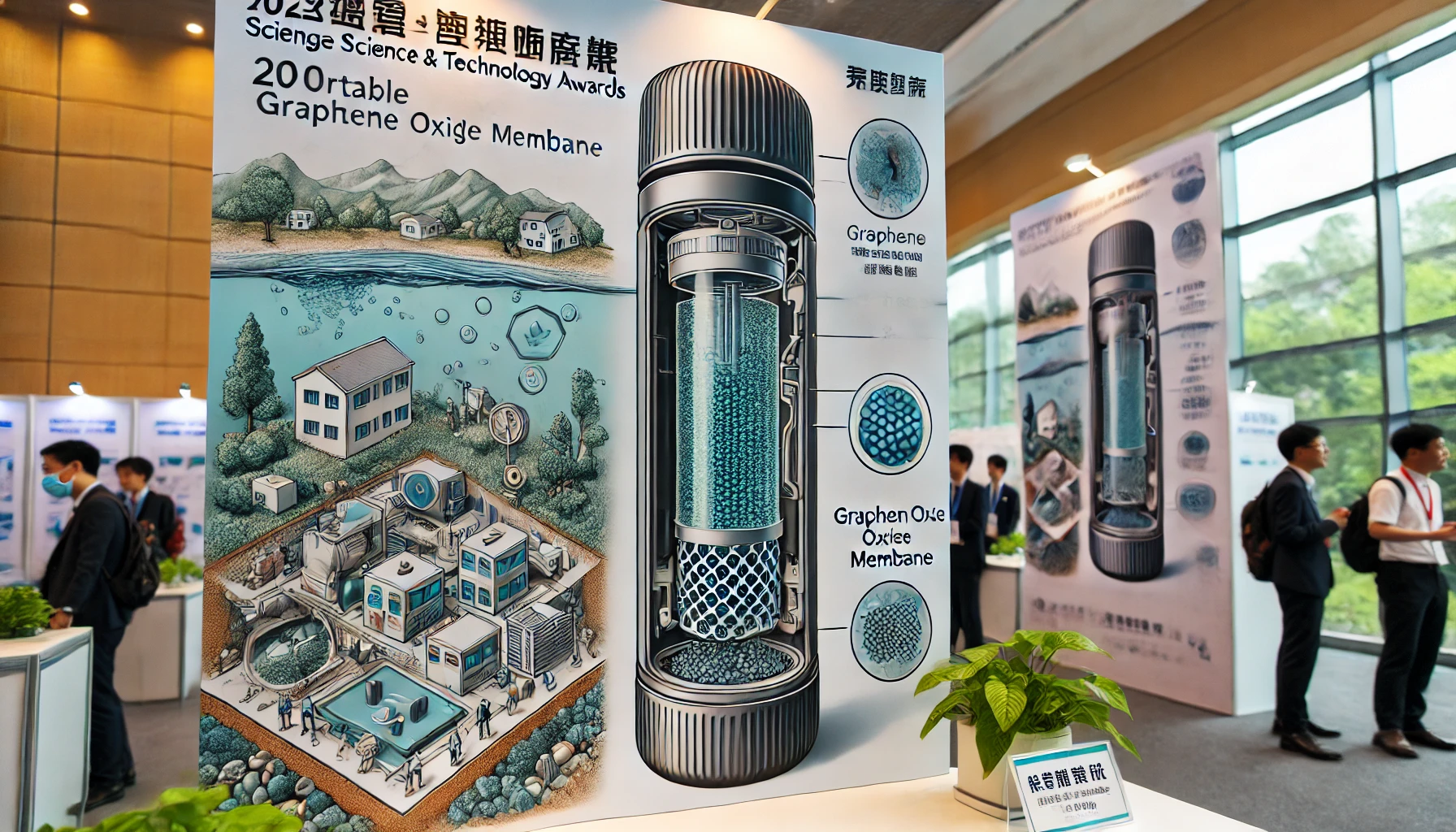
The principle behind this „thermos“ desalination device lies in its use of a special graphene oxide membrane – China

At the 2023 Shanghai Science and Technology Awards, a project led by researchers from East China University of Science and Technology received the First Prize in Natural Science for advancing desalination technology. Their innovation, a portable desalination device using a graphene oxide membrane, allows seawater to be efficiently converted into fresh water. The graphene-based membrane operates by blocking salt ions while letting water molecules pass through, achieving 15 times the water flux of conventional membranes. Recognized in the Shanghai Green Technology Directory, this device offers a significant leap in sustainable water purification solutions.

(Source)

The principle behind this „thermos“ desalination device lies in its use of a special graphene oxide membrane – China2024-10-30T18:30:35+01:00

Salt-resistant MXene-charge gradient hydrogel evaporator with boosted water transport for efficient photothermal desalination – China

Highlights

  • We introduce an efficient vXene-charge gradient hydrogel (MCGH) evaporator using the Donnan effect for salt rejection.
  • 2D MXene films harvest sunlight effectively, converting light energy into heat for water evaporation in desalination.
  • This solar steam generator uses an ion pumping effect and gradient porous structure for high osmotic pressure and salt barrier.

(Source)

Salt-resistant MXene-charge gradient hydrogel evaporator with boosted water transport for efficient photothermal desalination – China2024-10-08T11:07:08+02:00

Fe-MOF derived Fe3O4/C-based hydrogel for efficient solar-driven photothermal evaporation – China

Solar-driven interfacial photothermal evaporation (SIPE) has been considered as a green and sustainable technology for obtaining fresh water, and the exploring efficient photothermal materials is crucial. Nanocomposite derived from metal-organic framework exhibits high light absorption properties and excellent chemical stability, making it an ideal candidate in the SIPE.

(Source)

Fe-MOF derived Fe3O4/C-based hydrogel for efficient solar-driven photothermal evaporation – China2024-09-29T17:02:27+02:00

Chinese scientists develop new material for seawater desalination – China

The research team led by Zhang Xuan, a professor at the Nanjing University of Science and Technology, developed the polyester reverse osmosis membrane, which overcame several limitations of mainstream commercial polyamide membranes, providing a new solution for the next generation of seawater desalination technology.

(Source)

Chinese scientists develop new material for seawater desalination – China2024-07-01T23:43:14+02:00

Chinese scientists develop new material for seawater desalination – China

The research team led by Zhang Xuan, a professor at the Nanjing University of Science and Technology, developed the polyester reverse osmosis membrane, which overcame several limitations of mainstream commercial polyamide membranes, providing a new solution for the next generation of seawater desalination technology.

(Source)

Chinese scientists develop new material for seawater desalination – China2024-06-06T17:59:15+02:00
Nach oben