A general modeling framework for FO spiral-wound membrane and its fouling impact on FO-RO desalination system (Malaysia)

A comprehensive modeling framework for fouling in forward osmosis (FO) spiral-wound membrane (SWM) modules has been developed, addressing the challenges of time-dependent fouling and complex flow patterns induced by baffles, with validation against experimental data showing a maximum error of 13.1% in FO permeate flux.

The validated model reveals that while improved operating conditions and membrane parameters initially enhance water flux, these gains are significantly offset by accelerated fouling, resulting in minimal performance improvements (<1%) under severe fouling conditions.

This study demonstrates that for foulant cakes with pore diameters larger […]

A general modeling framework for FO spiral-wound membrane and its fouling impact on FO-RO desalination system (Malaysia)2024-11-09T09:34:10+01:00

Structure-function relationship for functional films with constructed graded channels in dye/salt separation and fouling resistance (China)

A novel composite film, constructed through polypyrrole particle stacking and polydopamine space-filling, demonstrates exceptional performance in dye/salt separation with high water flux (>600 L m⁻² h⁻¹ bar⁻¹) and near-perfect dye rejection (~100%).

The film’s unique patterned surface structure, created by microsphere arrangement and inter-structure adaptation assembly, provides excellent contamination tolerance and rinsing regeneration capabilities, while computational fluid dynamics simulations reveal that high shear stress and vortex flow in interstitial spaces reduce contaminant deposition.

This innovative composite film, exhibiting good structural stability and mechanical strength in complex water environments, unveils crucial […]

Structure-function relationship for functional films with constructed graded channels in dye/salt separation and fouling resistance (China)2024-11-09T09:30:55+01:00

Fabrication of green xylose-based nanofiltration membrane with enhanced performance and chlorine resistance (China)

Nanofiltration technology is essential for drinking water purification, yet oxidizing agents in pretreatment can degrade membrane performance.

This study introduces a polyester nanofiltration membrane using xylose, providing a hydrophilic, thin separation layer with high permeance (28.7 L·m²·h⁻¹·bar⁻¹) and strong Na₂SO₄ rejection (95.4%).

With robust chlorine resistance and stability across pH levels, this green monomer-based membrane offers an effective, sustainable approach to enhancing nanofiltration durability and efficiency.

(Source)

Fabrication of green xylose-based nanofiltration membrane with enhanced performance and chlorine resistance (China)2024-11-05T08:54:56+01:00

One-pot synthesis of composite metal-organic framework for enhanced water adsorption (China)

Metal-organic frameworks (MOFs) present a promising approach to atmospheric water harvesting (AWH), though their effectiveness varies across humidity conditions.

This study developed composite MOFs (CMOFs) with hygroscopic salts using a one-pot hydrothermal synthesis to boost water uptake, optimizing aluminum sources and dispersants.

Results showed that CMOF-303-NaOH exhibited stable and high water adsorption (up to 2.05 g·g⁻¹ at 95% RH), offering a novel method to improve MOF performance in AWH applications.

(Source)

One-pot synthesis of composite metal-organic framework for enhanced water adsorption (China)2024-11-04T17:04:09+01:00

Impact of membrane surface and module damage on virus removal and integrity in RO membranes (Netherlands)

Reverse osmosis (RO) membranes are effective for removing viruses and salts, yet their long-term integrity in full-scale spiral wound systems can be compromised by component and surface damage.

This study evaluates how various types of module damage—component, oxidative, and surface—affect virus removal using biological (natural virus markers) and non-biological (salt, rhodamine WT, pyranine) indicators.

Results highlight that while natural virus markers best reveal virus rejection capacity in compromised modules, fluorescent solutes more accurately assess active layer damage, underscoring the need for multiple indicators in membrane integrity assessments.

Impact of membrane surface and module damage on virus removal and integrity in RO membranes (Netherlands)2024-11-04T16:39:45+01:00

Thermal seawater desalination for irrigation purposes in a water-stressed region: Emerging value tensions in full-scale implementation (Spain)

Water scarcity in arid regions has accelerated the adoption of desalination technologies, yet these often carry high energy costs and environmental impacts, particularly due to brine discharge.

This study examines societal concerns and conflicts linked to developing a solar-powered thermal desalination system for irrigation in Spain’s water-stressed Almería region, aiming for resource recovery and circular water economy.

Through a context-sensitive, participatory design, technical scenarios were evaluated alongside stakeholder feedback, highlighting the need for sustainable, socially accepted desalination solutions that balance environmental, economic, and social considerations.

(Source)

Thermal seawater desalination for irrigation purposes in a water-stressed region: Emerging value tensions in full-scale implementation (Spain)2024-11-04T16:31:04+01:00

Global Review of last two weeks

Seawater desalination has become an increasingly important technology in addressing water scarcity issues worldwide. As climate change and population growth continue to strain freshwater resources, many countries are turning to desalination as a viable solution. Recent advancements in the field have focused on improving energy efficiency, reducing environmental impacts, and increasing production capacity. Here are the latest developments in seawater desalination from the past 13 days:

• Veolia has won a USD320 million contract to engineer and supply key technology for the Hassyan seawater desalination plant in Dubai, UAE, which will be the world’s […]

Global Review of last two weeks2024-11-04T16:03:02+01:00

Capacitive lithium capture system using a mixed LiMn2O4 and LiAlO2 material – Qatar

This study explores an innovative approach for selective lithium recovery using membrane-based capacitive deionization (MCDI) with electrode materials derived from spent Li-ion batteries. The mixed LiMn2O4/LiAlO2 cathode demonstrated superior performance, achieving 83.1% Li recovery efficiency and 38.15 mg/g deionization capacity. MCDI offers advantages such as fast processing, high removal capacities, and regeneration ability, contributing to a more sustainable lithium circular economy. The promising results lay a foundation for future research to optimize electrode materials and system design, addressing the increasing lithium demand while minimizing environmental impact.

(Source)

Capacitive lithium capture system using a mixed LiMn2O4 and LiAlO2 material – Qatar2024-11-03T13:24:15+01:00

Air gap membrane distillation unit operated by thermoelectric module – KSA

The innovative TEM-AGMD technology combines membrane distillation with thermoelectric modules, allowing for the elimination of numerous components found in traditional MD systems. This compact and energy-efficient approach enables decentralized water treatment and desalination with excellent salt rejection and minimal power consumption. Optimal performance is achieved by increasing the number of thermoelectric modules, implementing multi-stage membrane distillation, and intensifying the feed flow rate. The TEM-AGMD technology shows great potential for developing hybrid systems for decentralized water treatment and desalination, achieving a minimal specific energy consumption of 962 kWh/m³.

(Source)

Air gap membrane distillation unit operated by thermoelectric module – KSA2024-10-30T18:32:15+01:00

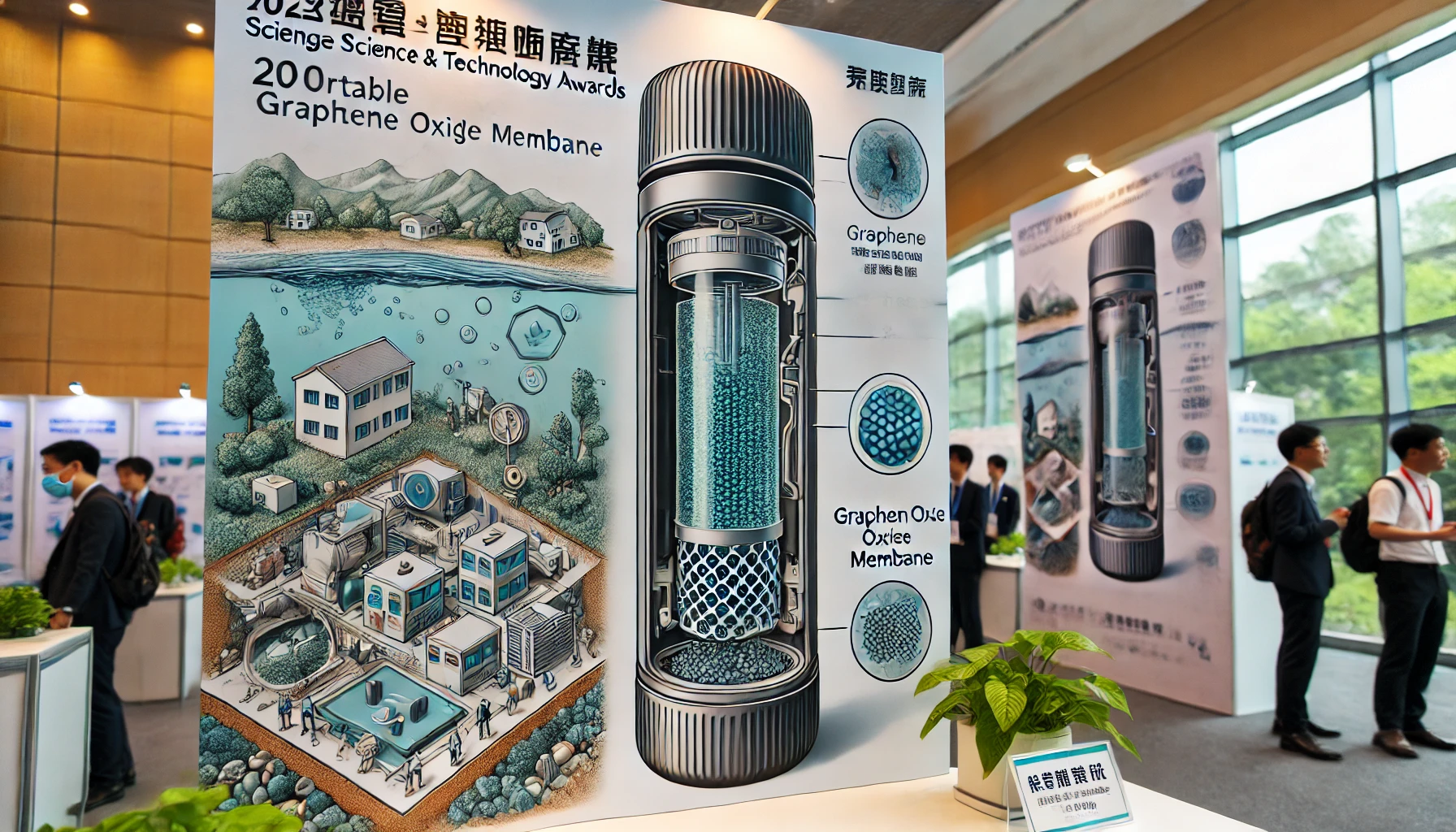
The principle behind this „thermos“ desalination device lies in its use of a special graphene oxide membrane – China

At the 2023 Shanghai Science and Technology Awards, a project led by researchers from East China University of Science and Technology received the First Prize in Natural Science for advancing desalination technology. Their innovation, a portable desalination device using a graphene oxide membrane, allows seawater to be efficiently converted into fresh water. The graphene-based membrane operates by blocking salt ions while letting water molecules pass through, achieving 15 times the water flux of conventional membranes. Recognized in the Shanghai Green Technology Directory, this device offers a significant leap in sustainable water purification solutions.

(Source)

The principle behind this „thermos“ desalination device lies in its use of a special graphene oxide membrane – China2024-10-30T18:30:35+01:00
Nach oben