Capacitive lithium capture system using a mixed LiMn2O4 and LiAlO2 material – Qatar

This study explores an innovative approach for selective lithium recovery using membrane-based capacitive deionization (MCDI) with electrode materials derived from spent Li-ion batteries. The mixed LiMn2O4/LiAlO2 cathode demonstrated superior performance, achieving 83.1% Li recovery efficiency and 38.15 mg/g deionization capacity. MCDI offers advantages such as fast processing, high removal capacities, and regeneration ability, contributing to a more sustainable lithium circular economy. The promising results lay a foundation for future research to optimize electrode materials and system design, addressing the increasing lithium demand while minimizing environmental impact.

(Source)

Capacitive lithium capture system using a mixed LiMn2O4 and LiAlO2 material – Qatar2024-11-03T13:24:15+01:00

Air gap membrane distillation unit operated by thermoelectric module – KSA

The innovative TEM-AGMD technology combines membrane distillation with thermoelectric modules, allowing for the elimination of numerous components found in traditional MD systems. This compact and energy-efficient approach enables decentralized water treatment and desalination with excellent salt rejection and minimal power consumption. Optimal performance is achieved by increasing the number of thermoelectric modules, implementing multi-stage membrane distillation, and intensifying the feed flow rate. The TEM-AGMD technology shows great potential for developing hybrid systems for decentralized water treatment and desalination, achieving a minimal specific energy consumption of 962 kWh/m³.

(Source)

Air gap membrane distillation unit operated by thermoelectric module – KSA2024-10-30T18:32:15+01:00

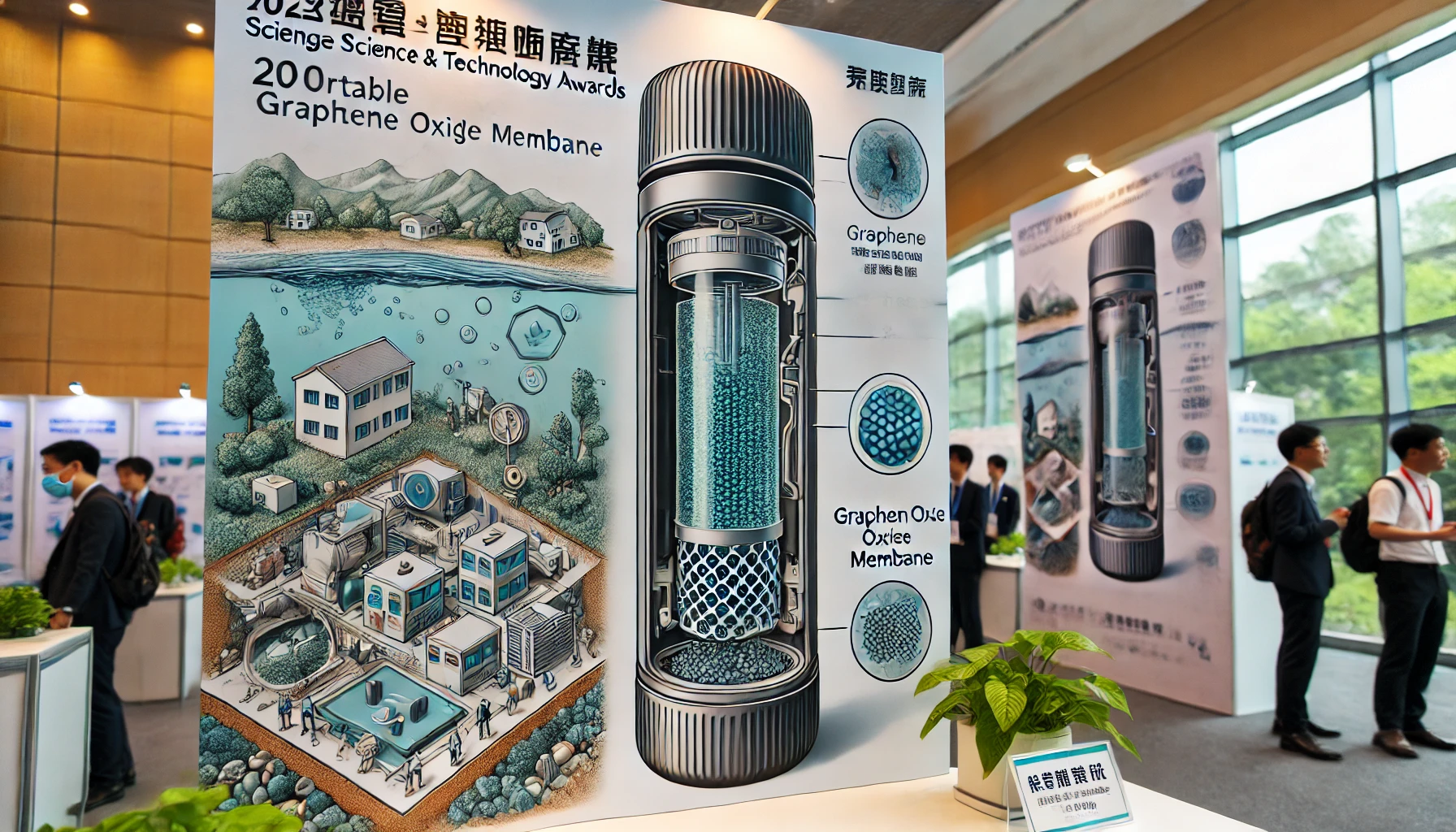
The principle behind this „thermos“ desalination device lies in its use of a special graphene oxide membrane – China

At the 2023 Shanghai Science and Technology Awards, a project led by researchers from East China University of Science and Technology received the First Prize in Natural Science for advancing desalination technology. Their innovation, a portable desalination device using a graphene oxide membrane, allows seawater to be efficiently converted into fresh water. The graphene-based membrane operates by blocking salt ions while letting water molecules pass through, achieving 15 times the water flux of conventional membranes. Recognized in the Shanghai Green Technology Directory, this device offers a significant leap in sustainable water purification solutions.

(Source)

The principle behind this „thermos“ desalination device lies in its use of a special graphene oxide membrane – China2024-10-30T18:30:35+01:00

Energy Recovery secures $12M in UAE desalination deals – UAE

Energy Recovery (NASDAQ) has secured over $12 million in contracts to supply PX Pressure Exchanger devices for three seawater desalination projects in the UAE. The projects will create nearly 1 million cubic meters of desalination capacity per day, with one involving a floating desalination barge in the Arabian Gulf. This offshore solution addresses the lack of coastal land and offers an innovative approach for water-scarce regions.

(Source)

Energy Recovery secures $12M in UAE desalination deals – UAE2024-10-25T13:23:14+02:00

Four new desalination units in the works to combat water shortage – Philippines

The Water Development Department has announced plans to address water supply issues in Limassol and Paphos, officials told a parliamentary committee on Tuesday.

The strategy includes four new mobile desalination units nearing final design stages, as well as two permanent units slated for Limassol and Larnaca. Existing facilities are also set for expansion to combat potential water cuts following recent years of drought.

(Source)

Four new desalination units in the works to combat water shortage – Philippines2024-10-25T13:23:12+02:00

Competitive water adsorption for low-energy desalination: Insights from statistical physics theory – Tunisia

… the statistical physics theory has been deployed to unlock the mysteries of water molecule binding on Zeolite and Silica Gel at the microscopic level. The adopted computational procedure, based on the grand canonical partition function, provided physical insights of the docking mechanism by scrutinizing the stereographic and energetic variables.

(Source)

Competitive water adsorption for low-energy desalination: Insights from statistical physics theory – Tunisia2024-10-18T10:19:09+02:00

Assessment of salt-free electrodialysis metathesis: A novel process for brine management in brackish water desalination using monovalent selective ion exchange membranes – USA

Since reverse osmosis (RO) is often limited to a water recovery of 70–85 %, implementing a secondary process like electrodialysis metathesis (EDM) to treat concentrate can increase system water recovery. This study explores salt-free electrodialysis metathesis (SF-EDM) as an alternative to conventional EDM to investigate its performance in the zero discharge desalination (ZDD) process. SF-EDM utilizes monovalent-selective ion exchange membranes, eliminating the need for sodium chloride (NaCl) as a substitution solution.

(Source)

Assessment of salt-free electrodialysis metathesis: A novel process for brine management in brackish water desalination using monovalent selective ion exchange membranes – USA2024-10-13T12:14:06+02:00

Salt-resistant MXene-charge gradient hydrogel evaporator with boosted water transport for efficient photothermal desalination – China

Highlights

  • We introduce an efficient vXene-charge gradient hydrogel (MCGH) evaporator using the Donnan effect for salt rejection.
  • 2D MXene films harvest sunlight effectively, converting light energy into heat for water evaporation in desalination.
  • This solar steam generator uses an ion pumping effect and gradient porous structure for high osmotic pressure and salt barrier.

(Source)

Salt-resistant MXene-charge gradient hydrogel evaporator with boosted water transport for efficient photothermal desalination – China2024-10-08T11:07:08+02:00

Advances and challenges in capacitive deionization: Materials, architectures, and selective ion removal – Unites Kingdom

Capacitive Deionization (CDI) is an emerging, eco-friendly desalination technology gaining momentum. This review covers key topics in CDI, including electrode materials, cell architectures, selective ion removal, energy consumption, and salinity ranges. Key improvements include optimizing carbon materials with surface functional groups, heteroatom doping, and metal oxide modifications. The use of Faradaic materials has significantly increased CDI’s desalination capacity. Innovations in cell architecture from static to flow electrodes allow for continuous production, boosting energy efficiency and expanding CDI’s salinity range. Future research should focus on ion-selective mechanisms, electrode stability, hydraulic design, and economic and environmental assessments to enhance scalability […]

Advances and challenges in capacitive deionization: Materials, architectures, and selective ion removal – Unites Kingdom2024-09-29T18:16:59+02:00

Fe-MOF derived Fe3O4/C-based hydrogel for efficient solar-driven photothermal evaporation – China

Solar-driven interfacial photothermal evaporation (SIPE) has been considered as a green and sustainable technology for obtaining fresh water, and the exploring efficient photothermal materials is crucial. Nanocomposite derived from metal-organic framework exhibits high light absorption properties and excellent chemical stability, making it an ideal candidate in the SIPE.

(Source)

Fe-MOF derived Fe3O4/C-based hydrogel for efficient solar-driven photothermal evaporation – China2024-09-29T17:02:27+02:00
Nach oben